Creator-led marketing has become one of the fastest-growing areas of digital advertising in India. According to Kofluence’s Decoding Influence 2026 report, India’s influencer marketing industry is valued at ₹3,000–3,500 crore in 2025 and is projected to reach ₹4,500–5,000 crore by 2027, growing at a CAGR of around 22%. The report also highlights that brands are increasingly treating creator collaborations as measurable business investments rather than channels focused only on awareness.
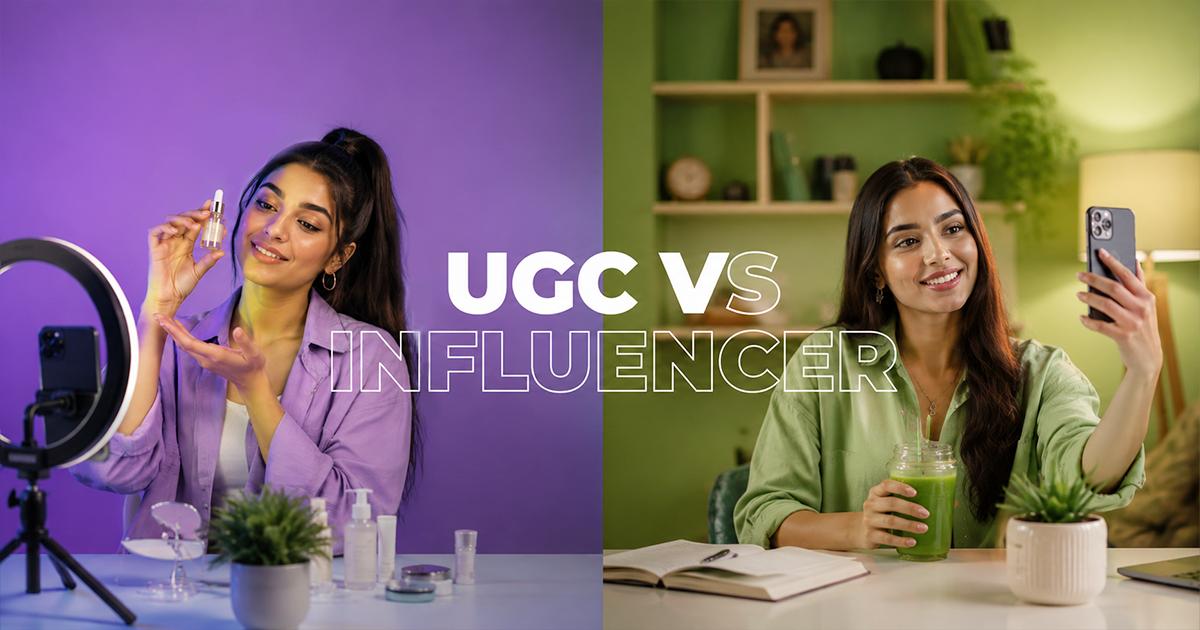
As businesses refine their creator strategies, one of the biggest decisions they face is UGC vs influencer marketing. Although both approaches involve creator-generated content, they are designed to achieve different marketing outcomes. Influencers help brands expand their reach through trusted communities, while UGC focuses on producing authentic, customer-style content that brands can reuse across paid advertising, websites, product pages, and social media.
Choosing the right strategy depends on your campaign objective. Whether you’re looking to build brand awareness, improve advertising performance, or drive more sales, understanding how these two approaches differ can help you invest in your marketing budget more effectively.
What Is UGC Marketing?
Authentic content generated by individuals that presents products or services in a natural and relatable way is known as User-Generated Content (UGC). Unlike traditional advertising, UGC is intended to be a true customer experience, and so is extremely effective at establishing trust.
UGC is a tactic brand often employing pay-for-performance campaigns, product pages, websites, social media, landing pages, and email marketing. The content is created specifically for the brand, which means that it may be used for a number of marketing channels, which makes it useful to the brand in the long term as a valuable creative asset.
What Is Influencer Marketing?
Influencer marketing is about working with content creators that have developed loyal communities on social media platforms like Instagram, YouTube, or LinkedIn. Rather than merely producing content, influencers post branded content on their channels, thereby enabling brands to harness their trustworthiness and reach.
This is a good strategy for product launches, awareness campaigns, community building, and social proof. Creating a partnership with an influencer who you already have a following on social media can help introduce products or services, and many people will listen to what they have to say.
Also read: UGC Campaign Strategies to Drive Higher ROI for Brands
UGC Marketing vs Influencer Marketing: A Side-by-Side Comparison
| Factor | UGC Marketing | Influencer Marketing |
|---|---|---|
| Primary Goal | Create authentic, reusable content that drives conversions. | Increase brand awareness through a creator’s audience. |
| Audience Reach | Shared through the brand’s own marketing channels. | Published directly to the influencer’s followers. |
| Content Ownership | Brands usually receive usage rights to reuse content across campaigns. | Usage rights depend on campaign agreements and may require additional permissions. |
| Best For | Paid ads, websites, product pages, email campaigns, and social media creatives. | Product launches, awareness campaigns, community engagement, and social proof. |
| Scalability | Easy to produce multiple creative variations for ongoing campaigns. | Scaling often requires collaborating with additional influencers. |
| Cost Efficiency | Offers long-term value because content can be repurposed. | Brands pay for both content creation and audience access. |
| Trust Factor | Builds trust through realistic customer-style experiences. | Builds trust through the influencer’s relationship with their audience. |
| Ideal Outcome | Better conversions and reusable marketing assets. | Greater visibility, engagement, and audience reach. |
Which Strategy Generates More Sales?
This will depend on your business goals.
If your marketing objective is to gain brand visibility in a timely manner, you can reach thousands (if not millions) of new customers via an existing audience with the help of influencer marketing.
But when it comes to driving conversions and sustaining long-term advertising results, UGC can sometimes outweigh influencer marketing. Real-life product demonstrations, testimonials and lifestyle videos tend to work well as they feel more like real-world customer experiences than slick advertisements.
That’s why the debate on UGC vs influencer marketing is cropping more for brands seeking the potential benefits of getting the best value from their marketing budget.
UGC Creators vs Influencers: Which Should Brands Choose?
So, when deciding between UGC creators and influencers, you must always consider your campaign goals as well.
UGC creators are perfect for brands who need content for their paid ads, their product listings, their websites, landing pages, and social media. What’s great about them is that they create content that resonates with people and can be reused in several campaigns.
Influencers, however, are more effective at sparking conversations, introducing their product to new audiences, and improving brand credibility through a trusted recommendation.
The UGC creators vs influencers debate is a false dichotomy, as there are successful businesses that combine and leverage both to move customers through the journey.
Also read: Why UGC Content Creation Is Driving Marketing in 2026
Can Brands Use Both UGC and Influencer Marketing?
Absolutely, in fact, many of the fastest-growing brands employ both strategies simultaneously and don’t consider them contradictory tactics. A Boston Consulting Group (BCG) report on India’s creator economy has revealed that approximately 70% of brands are set to double and triple their creator marketing budgets within the next 2-3 years, indicating the creator-driven marketing as a long-term growth strategy.
This investment is helping businesses develop campaigns throughout the entire funnel. Influencers can create awareness, start conversations and introduce new products to new audiences, whilst UGC are genuine pieces of content that can be repurposed across paid ads, websites, product pages, emails and remarketing for conversion initiatives.
Platforms such as Talentrack can make this easier by allowing brands to find influencers and UGC creators all within one ecosystem, enabling the creation of campaigns that meet various business objectives.

Conclusion
There is no definitive winner in the UGC vs influencer marketing debate because both strategies serve different purposes. Influencer marketing helps brands expand their reach and build credibility, while UGC delivers authentic, conversion-focused content that can be reused across multiple marketing channels.
For the best results, many brands combine both approaches. With platforms like Talentrack making it easier to discover influencers and UGC creators, businesses can build creator-led campaigns that drive awareness, engagement, and long-term growth.
Frequently Asked Questions
Can small businesses benefit from UGC and influencer marketing together?
Yes, small businesses can benefit from influencers to gain visibility and use UGC to develop affordable content for ads, web, and social media.
How do brands measure the success of creator marketing campaigns?
Brands generally monitor metrics like engagement, reach, click through, conversions, content performance, and ROI.
No, UGC content creators are selected not because they have a huge audience but because they are capable of creating content that is authentic and of good quality.