Disclaimer: This article is intended for general informational purposes and discusses the ASCI guidelines from an advertising and content-production perspective. It should not be treated as legal advice. Brands and advertisers should refer to the applicable guidelines, platform requirements and professional advice relevant to their specific campaigns.
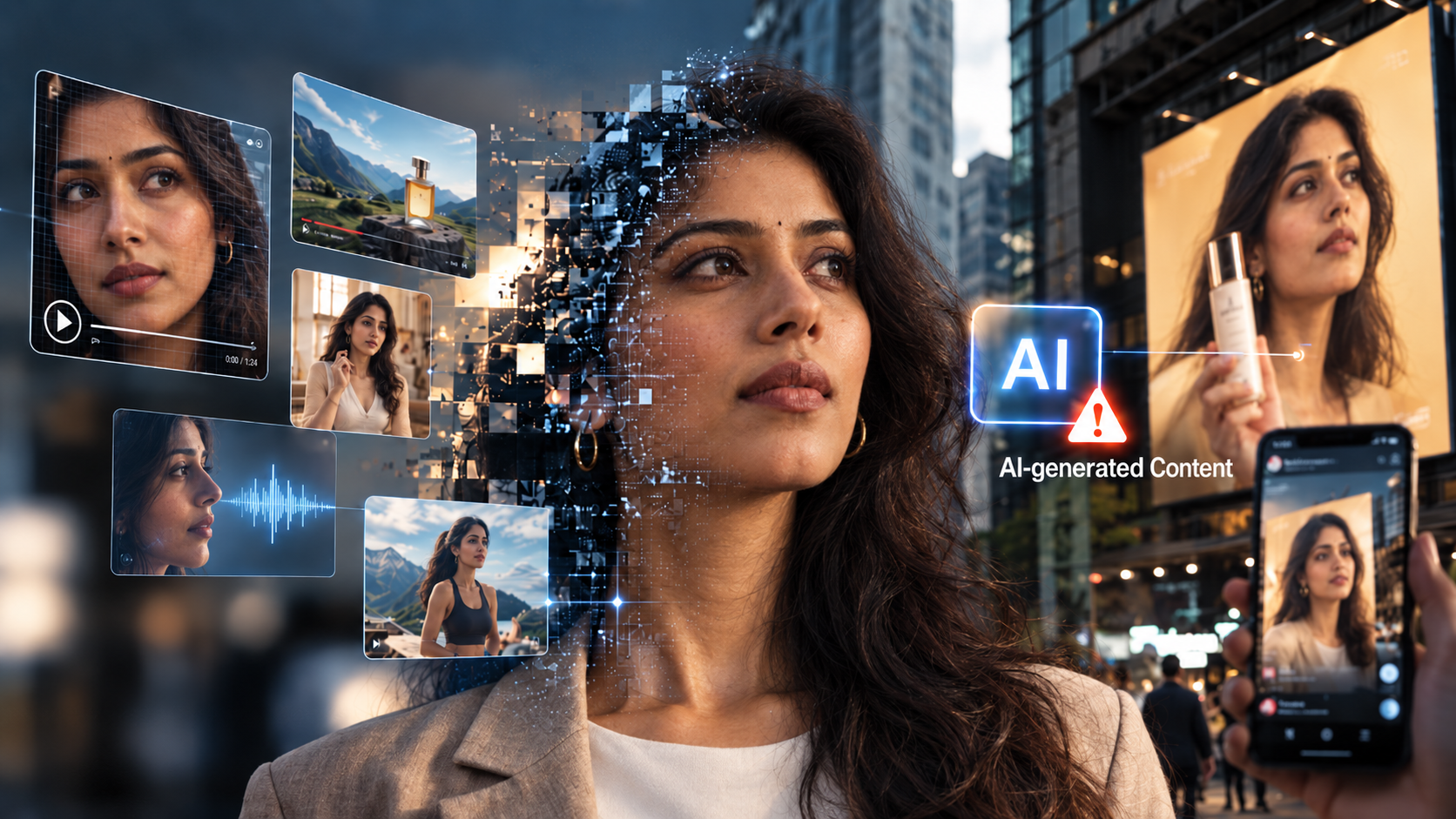
Artificial intelligence is quickly becoming part of everyday advertising. Brands are using AI to generate campaign visuals, create videos, replicate voices, build virtual influencers and even produce personalised versions of advertisements.
But does every use of AI in an advertisement need to be disclosed?
Not necessarily.
For brands and agencies experimenting with AI advertising, this creates an important distinction: AI use itself is not the only question. What the AI-generated element communicates to the consumer matters more.
What Counts as Synthetically Generated Content in Advertising?
Refer to advertising content that is generated synthetically, or material that has been synthetically modified, as part of the guidelines, and may be created or materially modified by technologies like artificial intelligence.
This could include:
- AI-generated people or influencers
- digitally recreated likenesses or voices
- AI-generated environments and scenarios
- synthetic product demonstrations
- AI-created sound effects
- realistic visual or audio representations that did not occur in the real world
Simultaneously, AI can be at work in other ways which have little or no impact on what the consumer understands. The guidelines recognise this distinction.
The key question is therefore not simply: Was AI used?
It is closer to: Could the synthetic element influence what the consumer believes about the person, product, service or situation being advertised? ASCI Online
When Does AI-Generated Advertising Need a Label?
According to ASCI’s framework, disclosure is required when synthetically generated content materially influences consumer decisions and the absence of disclosure could mislead consumers. ASCI Online
Here are some of the situations specifically covered.
-
AI-Generated Influencers and Brand Ambassadors
When an advert uses a synthetically created influencer or ambassador that may be mistaken for a real person, the fact that the person is synthetic must be disclosed.
With the rise of AI-generated humans that are becoming more lifelike, it’s not always easy to determine if the person you are viewing is real or not.
Marketers, this is the identity in the ad that’s now part of the transparency discussion.
-
Replicating a Real Person’s Likeness or Voice
If a real actor, creator or model has given a brand permission to create a personalised ad featuring their face or voice, then the brand is allowed to do so.
Where such consent is found, ASCI considers the duplication of a real person’s likeness or voice for personalised messaging to be a disclosure situation. ASCI Online
This distinction is important.
Consent and disclosure solve different problems.
Permission is a question of whether the person’s identity is allowed for that use. Disclosure indicates that the information being displayed or communicated is artificial.
If a brand is creating a campaign using AI actors or digital versions of real talent, both of these questions must be taken into account.
-
Fabricated Events or Settings
AI allows for placement of products virtually anywhere.
A car may be on a mountain road without driving on it. A fashion campaign can be created in an AI-generated city. A product can be part of a totally created environment.
A disclosure issue does not arise with all artificial backgrounds. But, ASCI requires labelling when a fabricated event or setting may impact the consumer’s perception of the product or service being advertised. ASCI Online
Again, it’s a matter of materiality.
A fantasy world that is clearly imaginative is not the same as a realistic setting that might cause the viewer to think something real about the offering.
-
Showing Products That Do Not Yet Exist
With the help of AI and 3D visualisation, brands can promote ideas even before a real product comes to market.
For instance, advertising could depict a future product, property or experience in a realistic synthetic demonstration.
Demonstrations of products not yet available are not included in the situations that require labelling in ASCI. ASCI Online
This enables the consumer to know that the image is not a real product, but rather a representation created.
-
AI-Generated Sound That Influences Product Perception
Disclosure can be non-visual.
ASCI also considers synthetic sounds to be highly relevant to a product’s core features to be disclosed. The guidelines are illustrated with the example of headphones. ASCI Online
Think of a commercial where AI-generated sound is played in a manner that seems to be of better quality.
When the synthetic representation influences the interpretation of the product’s performance, transparency is relevant.
-
Sponsored AI-Generated Product Suggestions
The guidelines also cover recommendations generated by AI.
If an AI-generated product suggestion is paid or sponsored, ASCI AI guidelines say the disclosure should include the following:
Sponsored by [Brand] ASCI Online
This becomes increasingly relevant as conversational interfaces and AI-generated recommendations become part of the consumer discovery journey.
Does Every AI-Generated Ad Need a Label?
No.
One of the most important aspects of the guidelines is that routine or low-impact uses of AI do not automatically require disclosure.
ASCI states that labelling is not required where synthetic content does not materially affect a consumer’s ability to make an informed choice. ASCI Online
Examples include:
Routine Editing
Basic enhancements such as:
- colour correction
- lighting adjustments
- noise reduction
- minor blemish removal
generally do not require AI disclosure simply because an AI-powered editing tool was involved.
Decorative or Ambient Elements
Synthetic elements used primarily for visual atmosphere or decoration may not require labelling where they do not affect the consumer’s interpretation of the product.
Obviously Fantastical Effects
A flying shoe, a talking building or an obviously impossible AI-generated world is less likely to be mistaken for reality.
ASCI therefore identifies clearly fantastical effects as an example where disclosure is not required. ASCI Online
AI-Written Advertising Copy
Using generative AI to help produce advertising copy does not, by itself, mean the final advertisement needs an AI label.
ASCI categorises administrative and text-based uses, including generating advertising copy, among uses where labelling is not required. ASCI Online
Accessibility Uses
AI may also support:
- subtitles
- translations
- accurate audio descriptions
These accessibility applications are similarly identified as examples where disclosure is not required. ASCI Online
Some AI Advertising Cannot Be Fixed With a Disclosure Label
There is another category marketers need to understand.
Some synthetic advertising practices may remain problematic even if the advertisement clearly states that AI was used.
ASCI identifies advertisements that are illegal, infringe rights, contain misleading claims or otherwise violate the ASCI Code as prohibited irrespective of whether an AI label appears. ASCI Online
Examples include:
- Fabricated endorsements or testimonials
- Misleading exaggeration of product performance
- presenting non-existent locations as real in a misleading manner
- using unauthorised copyrighted material
- using deepfakes or someone’s likeness without consent
In other words:
Disclosure creates transparency. It does not turn misleading or unauthorised content into acceptable advertising.
That is an important distinction for creative and marketing teams adopting generative AI.
What Should an AI Disclosure Look Like?
Where disclosure is required, ASCI provides examples including:
Audio/Video created using AI
or
Audio/Video enhanced using AI
Platform-provided AI labels may also be used. Brands can use alternative wording where it accurately communicates the nature of the synthetic content. ASCI also states that applicable disclosures should follow its existing guidelines on disclaimers. ASCI Online
For marketers, the practical objective should therefore be clarity rather than simply adding an AI-related phrase somewhere in the creative.
A consumer should be able to understand what has been synthetically created or altered.
A Simple AI Advertising Disclosure Checklist
Before publishing an AI-powered campaign, creative teams can ask:
| Question | What to consider |
| Does the ad show a person who is synthetically generated? | Disclosure may be required |
| Is a real person’s face or voice digitally replicated? | Confirm permissions and assess disclosure |
| Could an AI-generated environment be mistaken for a real one? | Consider whether it affects consumer understanding |
| Does AI visually or audibly demonstrate product performance? | Check whether it could influence purchase decisions |
| Is the advertisement showing a product that does not yet exist? | Disclosure may be required |
| Was AI only used for editing, copywriting or accessibility? | Disclosure may not be necessary under the ASCI examples |
| Does the content make a misleading claim or use someone’s likeness without permission? | An AI label does not resolve the underlying issue |
The purpose is not to treat AI as inherently risky. It is to identify where synthetic content changes what a consumer is being asked to believe.
AI Disclosure and the Rise of Licensed AI Talent
The new advertising environment also raises an important question for brands using AI-generated people:
Who is the person appearing in the content, and what permission exists to use their identity?
Generative AI can make faces, voices and human performances increasingly easy to reproduce. But commercial content involving recognisable human identities requires a different approach from simply generating another visual asset.
This is where Licensed AI Talent offers brands and agencies another model.
Instead of using an individual’s identity without a clearly defined arrangement, Licensed
AI Talent starts with real people who make their likeness available for AI-led content creation under agreed licensing terms.
Brands can then use the licensed identity as part of their AI production workflow to create campaign content across multiple formats, while working within the permissions agreed for that talent and project.
It does not remove the need to assess whether an advertisement requires AI disclosure. In fact, ASCI specifically identifies even consensual replication of a person’s likeness or voice for personalised messaging as an example where disclosure is required. ASCI Online
What licensing addresses is a different part of the equation: permission to use the human identity behind the AI content.
What This Means for Brands and Agencies
AI advertising is not just an experiment anymore.
Now creative teams can create campaigns more quickly, produce a variety of variations and create visual worlds that used to take much larger productions.
As the outputs get closer to reality, however, the lines between real, generated and enhanced are less obvious for consumers.
The direction of ASCI’s new framework is therefore relatively straightforward: transparency becomes especially important when synthetic content could change how consumers interpret an advertisement.
For marketers, the practical workflow increasingly looks like:
Create → Verify permissions → Assess consumer impact → Add disclosure where appropriate → Publish
Disclosure should be viewed as a final compliance sticker, but brands can also keep it in mind from the start of
AI content production.
This makes it more manageable to use AI creatively and not get lost in the communication process, which is about the person, product or claim in the middle of it all.