Disclaimer: This article is intended for general informational purposes and discusses developments in AI-powered advertising and content production. It should not be treated as legal or regulatory advice. Brands and agencies should independently assess the requirements relevant to their campaigns and use cases.
AI-generated content is becoming a bigger part of advertising in India. Brands are using AI for campaign videos, product visuals, digital presenters, AI actors, virtual influencers and other forms of synthetic content.
As adoption grows, transparency around AI-generated advertising is becoming increasingly important.
Recently, the Advertising Standards Council of India, or ASCI, introduced its Guidelines for Responsible Labelling of Synthetically Generated Content in Advertising. The guidelines focus on how brands should communicate the use of synthetic or materially altered content when it could affect how consumers interpret an advertisement.
For brands and agencies exploring AI video production, AI actors, AI models and synthetic advertising, the guidelines also highlight another important consideration: the source and permitted use of the human likeness appearing in AI-generated content. This is where Licensed AI Talent can play an increasingly relevant role.
What Are ASCI’s New AI Advertising Guidelines?
ASCI’s guidelines address synthetically generated content, or SGC, used in advertising. This can include audio, images or videos that have been artificially generated, materially modified or altered using AI or other computer-based technologies and presented in a way that could appear authentic. The focus is not simply on whether AI was used. Instead, the guidelines look at whether synthetic content could materially affect how consumers understand an advertisement, including cases involving unrealistic representations, misleading product claims, synthetic influencers or digitally replicated people.
For advertisers, this means the conversation around AI-generated advertising in India is moving beyond content creation itself and towards transparency, consumer understanding and responsible usage.
When Does AI-Generated Content Need Disclosure?
According to ASCI’s guidelines, disclosure becomes relevant where synthetically generated content could materially influence a consumer’s understanding or purchasing decision.
This can include advertising featuring:
- AI-generated or synthetic influencers
- Digitally replicated human likenesses
- AI-generated or replicated voices
- Materially altered images or videos
- Synthetic representations that could reasonably appear authentic
The guidelines also recognise that not every use of AI requires the same treatment.
Routine production changes such as colour correction, minor lighting adjustments or standard image enhancements may not require AI labelling where they do not materially change what is being represented. For brands, the key takeaway is that AI disclosure depends on how synthetic content is being used and what consumers may understand from it.
AI Actors, AI Models and Human Likeness
One of the most relevant areas of the guidelines for brands using AI actors or AI models is the treatment of human likeness. AI tools can now recreate, modify or generate highly realistic people at scale. This creates new possibilities for advertising, but it also raises an important question:
Where did the identity being used in the content come from?
A disclosure that content was generated using AI and permission to use an individual’s likeness are not the same thing. Disclosure is about what the audience sees. Consent and licensing relate to how the underlying human identity is being used. For brands and agencies scaling AI-led advertising, both considerations are increasingly important.
What Is Licensed AI Talent?
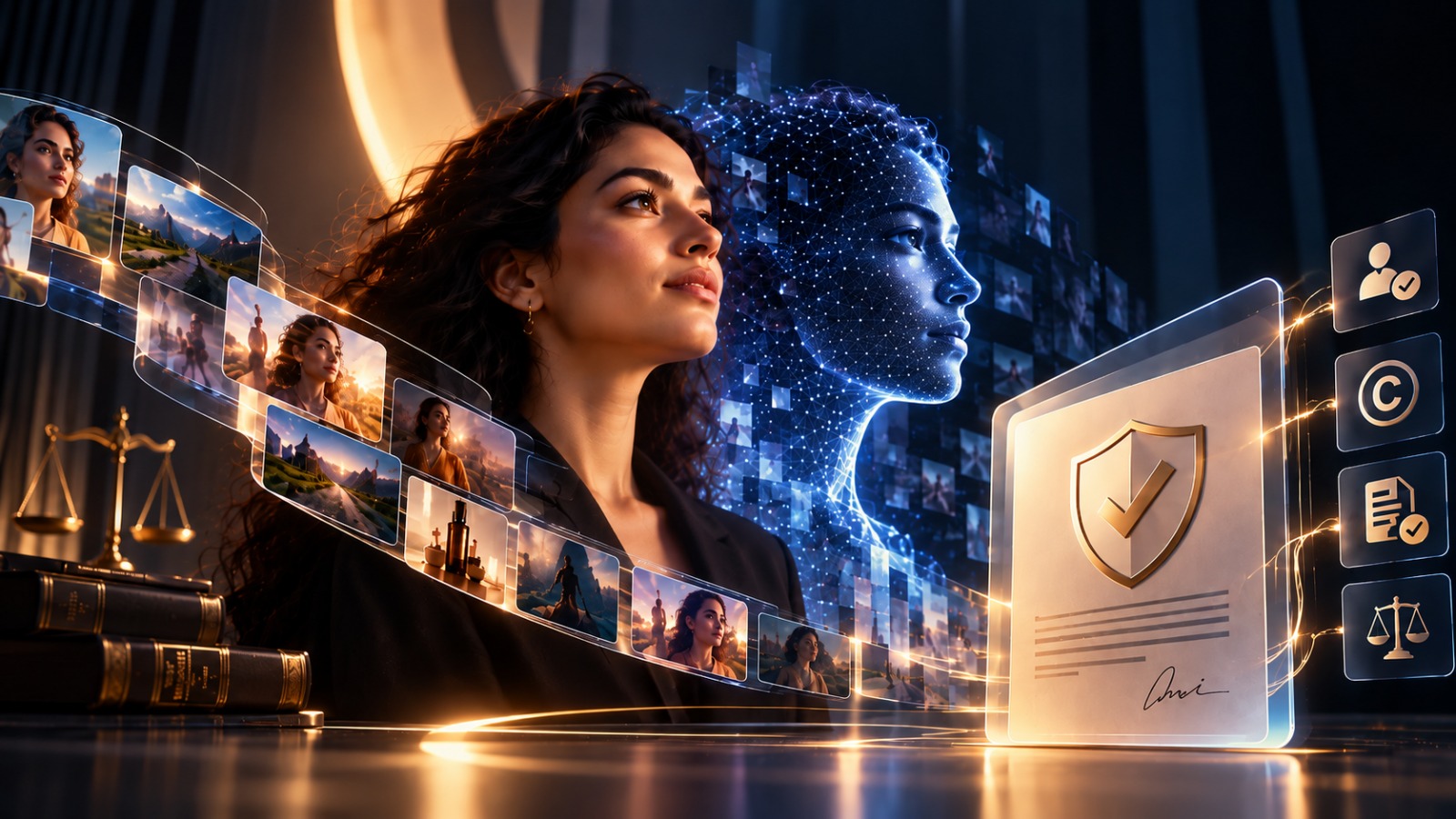
Licensed AI Talent refers to real people whose likeness can be used for defined AI-powered content creation under agreed permissions and licensing terms.
Instead of relying on an unknown face, a stock image or an identity sourced without clear usage context, brands can select real talent who have agreed to participate in AI-led content creation.
Talentrack’s Licensed AI Talent network enables brands and agencies to discover real models, actors and creators whose likeness can be used for suitable AI-generated content projects, subject to the agreed usage terms for each talent and campaign.
This can help teams bring more structure to the use of human identities in AI production.
How Licensed AI Talent Can Support Responsible AI Content Production
As AI content production scales, brands may generate dozens or even hundreds of creative variations from a single campaign idea.
A licensed talent approach can provide a clearer foundation for that process.
-
Consent-led AI content creation
The underlying talent has agreed to participate in AI-powered content creation under defined permissions. This helps brands distinguish between authorised use of a real person’s identity and content created from an uncertain or unauthorised source.
-
Defined usage parameters
Different campaigns may require different formats, markets, durations and content applications. Licensed AI Talent allows the intended usage of a person’s likeness to be defined according to the relevant licensing arrangement.
-
Greater traceability
Creative teams know the identity behind the AI-generated representation. This can be particularly useful when brands need consistency across campaign videos, social media content, digital advertising, e-commerce imagery or branded content.
-
Scalable creative production
Once a suitable Licensed AI Talent is selected, brands can build multiple AI-generated creative directions around the same identity, subject to the applicable project permissions. This can support faster and more scalable AI production without treating a human face as an anonymous generative asset.
Licensed AI Talent vs Fully Synthetic AI Faces
Brands today can broadly work with two types of AI-generated people. One approach uses completely synthetic faces created by an AI system. Another uses the licensed likeness of a real person. Both may have creative applications, but the underlying model is different.
With Licensed AI Talent, the person behind the digital representation is identifiable and their participation is based on defined permissions.
This can be particularly relevant for brands looking to build long-term AI campaigns featuring consistent human identities. It also gives creative teams greater clarity around who the digital representation is based on and how that likeness may be used.
AI Disclosure Is Only One Part of Responsible AI Advertising
ASCI’s guidelines also make an important distinction: adding an AI disclosure does not automatically make every advertisement acceptable. Brands still need to consider the broader representation being created.
For example:
- Does the advertisement accurately represent the product?
- Is a person’s likeness being used with appropriate permission?
- Could the AI-generated content create a misleading impression?
- Is an endorsement being represented accurately?
- Does the final creative clearly communicate synthetic content where appropriate?
This makes responsible AI advertising a broader production consideration rather than simply a labelling exercise.
What the ASCI AI Guidelines Mean for Brands and Agencies
For brands, agencies and production teams, the new ASCI guidelines reinforce the need to think about AI content from the beginning of the creative process.
That includes understanding:
- where the human identity in an AI advertisement comes from.
- whether the likeness has been authorised for the intended use.
- how synthetic content is represented to audiences.
- whether appropriate AI disclosure is required.
- whether the final advertisement could create a misleading impression.
As AI video production in India becomes more widely adopted, these considerations are likely to become part of standard campaign planning.
Building a More Transparent AI Advertising Ecosystem
AI is giving brands new ways to create advertising at greater speed and scale. But the next stage of AI adoption will not only be about generating more content. It will also be about creating AI-powered advertising with greater transparency around the people, identities and representations involved. ASCI’s guidelines reflect this shift.
For brands and agencies using AI actors, AI models and other digitally generated human content, solutions such as Licensed AI Talent can provide a more structured starting point for AI-led production.
Talentrack connects brands and agencies with Licensed AI Talent for AI video production, digital advertising, e-commerce content, branded content and other AI-powered creative requirements.
As synthetic content becomes a larger part of advertising, responsible sourcing, defined permissions and clear communication can become increasingly important parts of the production process.