The development of visual storytelling has radically changed how brands communicate. In a digital landscape where everyone is fighting for a second of attention, standard video shoots often hit a ceiling. 3D design is the tool that breaks through it. Today, 3D Design in video production has emerged as a powerful tool that enhances realism, creativity, and immersive engagement across formats.
Whether it is brand videos and product tutorials or advertising initiatives and online marketing materials,3D imagery has moved from a ‘nice-to-have’ luxury to a core pillar of modern content creation. Below are ten key reasons why 3D Design in video production plays a critical role in modern content creation.
Key Reasons for 3D Design Matters in Modern Video Production
Added Visual Effect and Immersionality
Importance of 3D designing is that it can create hyper‑realistic environments and objects. Be it 3D designing in product design, an architectural walkthrough, or an animated sequence, 3D images bring depth, texture, light, and spatial realism that cannot be achieved with traditional graphics. This kind of immersion reinforces audience retention and emotional involvement.
High Quality Product Visualisation
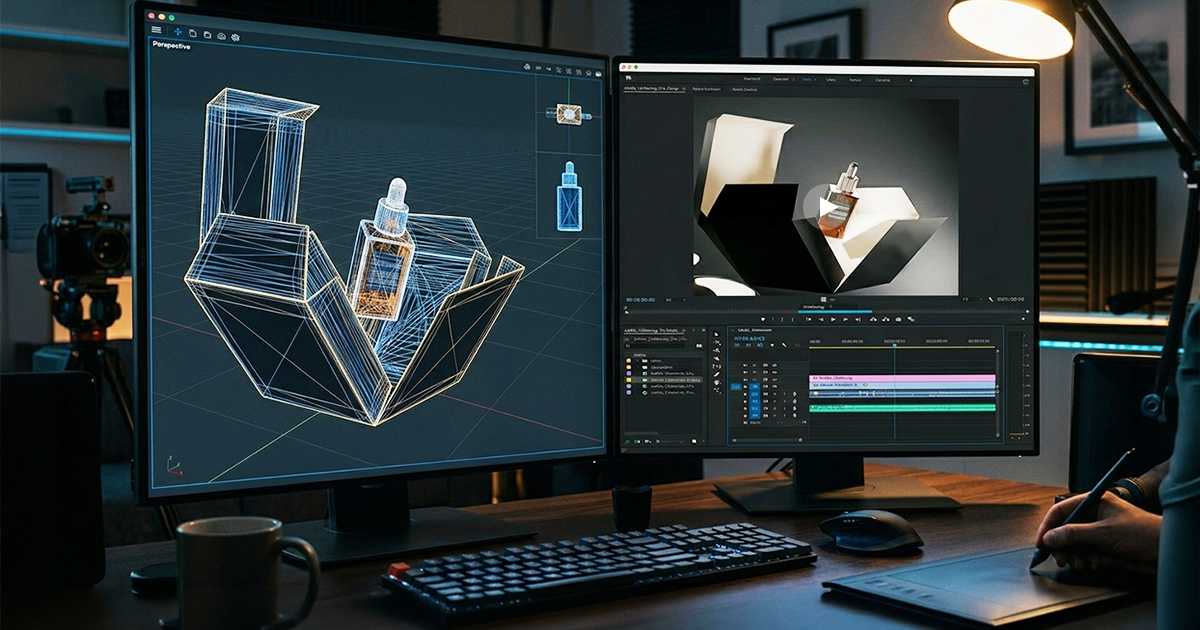
The use of 3D design in product visualisation has become unavoidable across the automotive, consumer electronics, real estate, and FMCG industries. Brands can present internal processes, illustrate how they work, and create visually sophisticated simulations without the need for physical prototyping. This lessens the limits of production but allows the stories to be told more vividly.
Freedom of Creativity No Physical Boundarie
Physical production is associated with logistical, financial, and geographical limitations. With 3D designers in India, creative teams can design environments that would otherwise be impossible or extremely expensive to build. It can scale seamlessly—from expansive futuristic cityscapes to highly detailed, close-up product visualisations.
Economic Efficiency Over the Long Run
Though it demands technical expertise to produce the 3D in the short run, it can be very economical in the long run. Scalable edits, reusable assets, and digital environments will reduce reshoot costs and location costs. This increases the popularity of 3D design production houses as a choice for brands that need to transverse their content across multiple formats.
Better Brand Dissociation
The contemporary spectators demand innovation. Competitive markets are characterized by brands that have adopted 3D design video. The presence of motion graphics, combined with animation and spatial depth, enhances perception and positions the brand as technologically ahead. Differentiation is not a choice; it is a necessity in a saturated digital feed.
Better Ability to Storytell
3D visual storytelling allows for simplifying complex ideas. Industries such as healthcare, fintech, SaaS, and manufacturing rely on 3D Design in video production to visually break down technical processes. When abstract data is translated into a dimensional animation, it becomes instinctive.
One Asset, Infinite Channels
A single 3D model is a gift that keeps on giving. Whether it’s an AR filter, a social media snippet, or a high-res web banner, 3D assets ensure your brand looks consistent everywhere without starting from scratch every time. The significance of 3D Design becomes evident when brands need to reach their audience across multiple channels while maintaining visual consistency in their communication.
Creative Accuracy that is Data Driven
Modern production thrives on agility. With 3D, you don’t need a reshoot to change a product’s color or the lighting of a scene—you just tweak the data. 3D-enabled features speed up production: colours, angles, lighting, product variations, and backgrounds can all be amended digitally, with no shots retaken. Such agility allows optimising performance on paid campaigns and digital launches.
Interaction with Emerging Technologies
The 3D Design integrates flawlessly with AR, VR, metaverse experiences, and interactive content. As immersive technologies gain traction, 3D design becomes foundational rather than optional. Immersive aesthetic ecosystems built on 3D structures are inherently tied to the future of video production.
The Availability of 3D Talent in India
The surge of specialized 3D talent in India has turned the country into a global hub for visual innovation. From international ad campaigns to gaming, Indian creators are bridging the gap between high-end technical execution and competitive scale.
The Strategic 3D in Contemporary Production
The conversation is no longer about whether to use 3D; it is about how effectively it can be integrated into a broader creative strategy. 3D enhances brand storytelling, product clarity, and technological positioning. With increased participation and immersive storytelling requirements across industries, businesses are increasingly concerned with engaging specialised 3D design and production houses that combine artistic direction and technical execution.

Conclusion
Visual sophistication has a direct impact on brand perception in a modern, digital-based economy. The significance of 3D Design is not just about aesthetics; it also extends to the operation of performance marketing, product education, experiential campaigns, and scalable digital information. From product simulation to futuristic storytelling, 3D Design in video production is shaping the future of visual communication. Those brands that successfully implement 3D models become long-term leaders in innovation, interaction, and audience engagement.
Frequently Asked Questions
Why is 3D design important in modern video production?
3D design is important in modern video production since it would provide depth, realism and impact to the images which 2D graphics cannot provide. It also allows immersive experiences, high-quality animation, and sophisticated visual effects and allows brands and creators to create high-quality engaging content that attracts attention.
How does 3D design improve visual storytelling?
3D design enhances the storyline through realistic settings, dynamic characters and viewpoints that make stories a reality. It enables filmmakers and brands to present multifaceted ideas, emotions, and action on a more vivid level, and the content looks more interesting and memorable to the viewers.
How does 3D design remove creative limitations in video production?
3D design eliminates the creative restrictions of video production since it enables its creators to construct any environment, character, or effect digitally, not bound by the physical sets, props or locations. It allows unlimited experimentation, sophisticated animation, and fantastic imagery, which would be expensive or unfeasible in the world of reality.
How does 3D design enhance audience engagement?
3D design enhance audiance engagement by providing visual stimulating, engaging and immersive appeal. Life-like graphics, lively animation, and innovative views enhance the material and make it easier to remember, emotionally touching, and thus likely to retain viewers.